Taking Shape
How a Duo Show Comes Together

I first encountered Lauri Jones’s work at a Westminster alumni exhibition last fall. My artist friend Pamela Martinez, who teaches there, invited me to attend. The show was broad and varied, but one textile piece stood out immediately. It had a clarity and presence that felt closer to painting than to what people often expect from textiles.
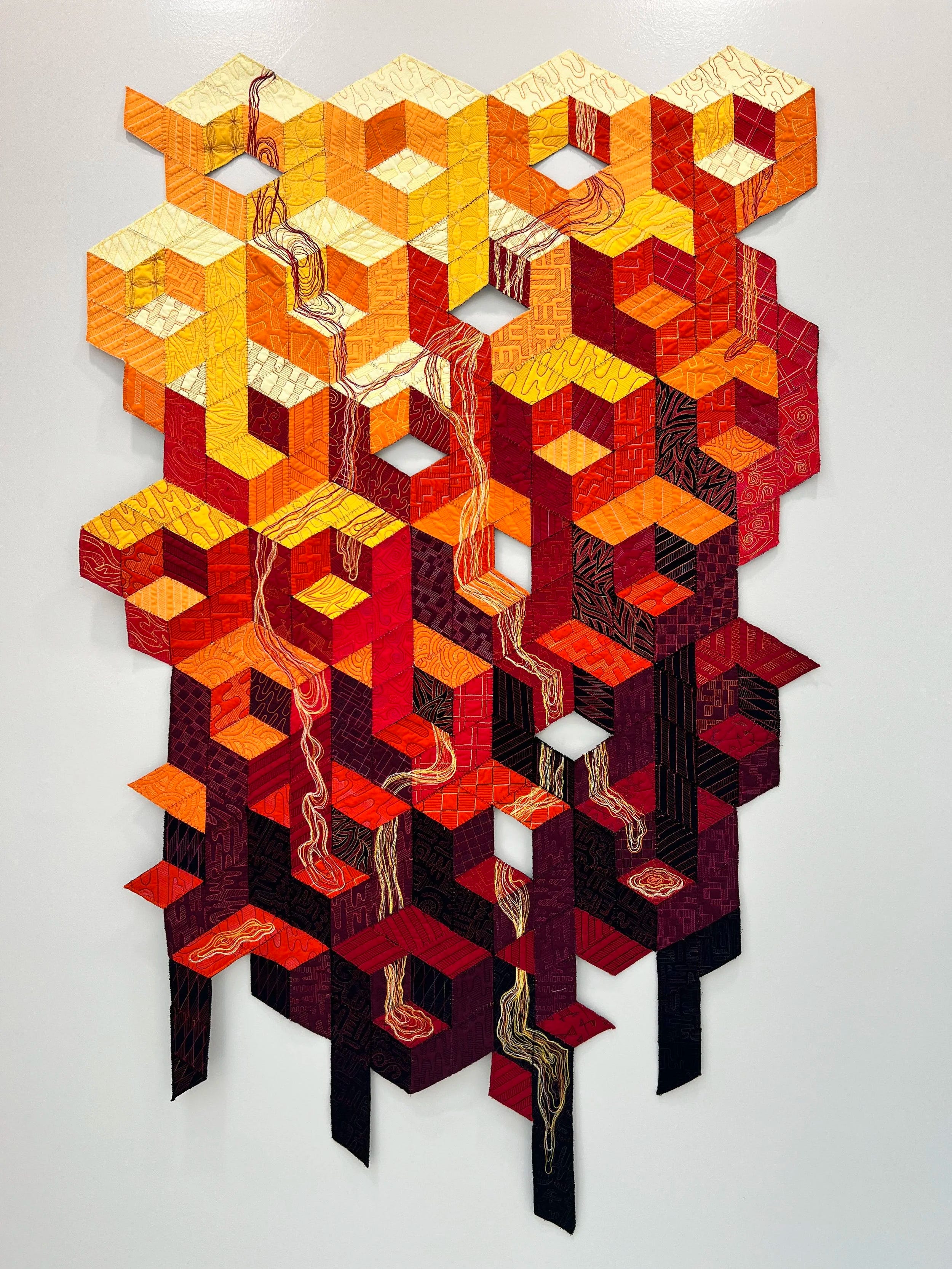
After meeting Lauri at the opening, I spent time with her website. The work stayed with me, intricate, disciplined, and modern in its language. To me, it felt like textile work informed by mid-century abstraction: pattern, line, rhythm, restraint. I emailed her to stay in touch and, without consciously planning anything, kept her work quietly pressing in the back of my mind.
Curating doesn’t always begin with a theme or a date. Sometimes it begins with attention.
Seeing Beyond Medium
Textiles are often framed as craft before they’re considered art. I don’t experience Lauri’s work that way.
What I respond to is formal language: geometry, repetition, structure, and visual rhythm. The medium matters, of course, but it’s secondary to how the work behaves in space and how it asks to be looked at.
The large-scale quilt Flow (2025) reimagines a traditional tumbling block pattern. There’s order in the geometry, but also movement, free-motion stitching that creates pathways beyond the structure. The piece holds tension between control and release, tradition and change. It’s visually disciplined, but emotionally open.
Knowing When an Artist Is “Next”
As I began thinking about my winter exhibit, I had the sense that this work belonged in the season ahead. Winter invites slower looking. It sharpens contrast. It asks for material presence.
Lauri’s work felt right for that moment, not because it was new to me, but because I was ready to place it in dialogue.
That’s often how I know an artist is “next.”
Why a Duo, Not a Solo
I rarely think in terms of solo shows.
Duo exhibitions allow for conversation, for tension, balance, and discovery. They ask viewers to move between works rather than settle into a single rhythm. Pairing isn’t about dilution; it’s about sharpening perception.
Around the same time Lauri’s work was lingering in my mind, I found myself at a house party hosted by my friend Ella. House parties like hers are a form of curation in themselves, carefully chosen guests, meaningful conversation, people who don’t all know one another but are open to connection.
That’s where I met Jeremy Morton.
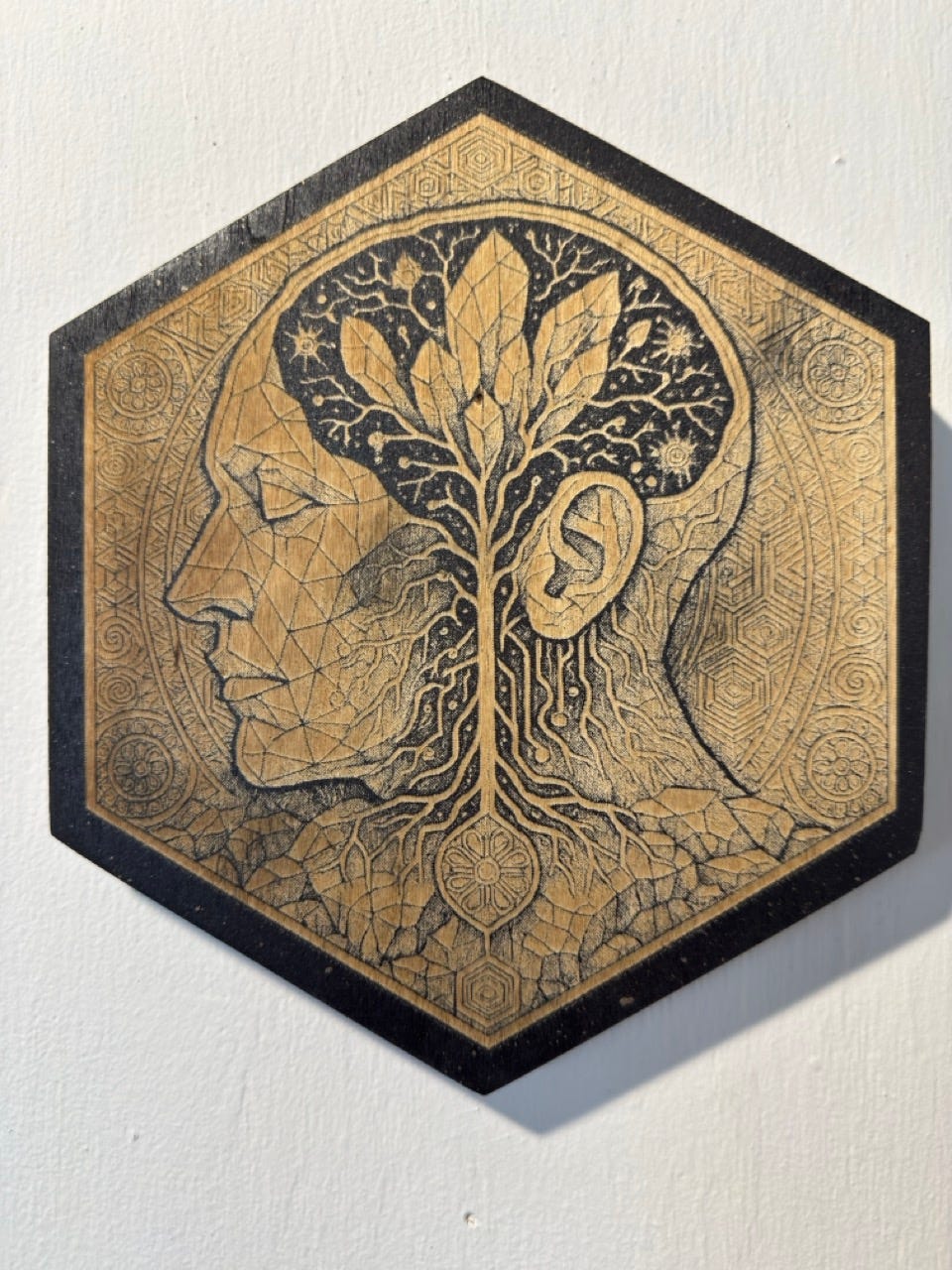
Jeremy followed up afterward, and we met for coffee at Le Bon Nosh. He’s warm, thoughtful, and deeply curious, qualities that often show up in the work before they show up in a biography. While he creates large-scale paintings and immersive projects, what stayed with me were his etched works in wood and slate. As I began thinking more concretely about the exhibit, the pairing clicked almost immediately.
Not conceptually but instinctively.
Finding the Counterpart
Jeremy’s work operates through a different material language: wood burn, slate, repetition, restraint. His process is slow and deliberate, shaped by discipline and recovery. There’s a physicality to the work, but also precision.
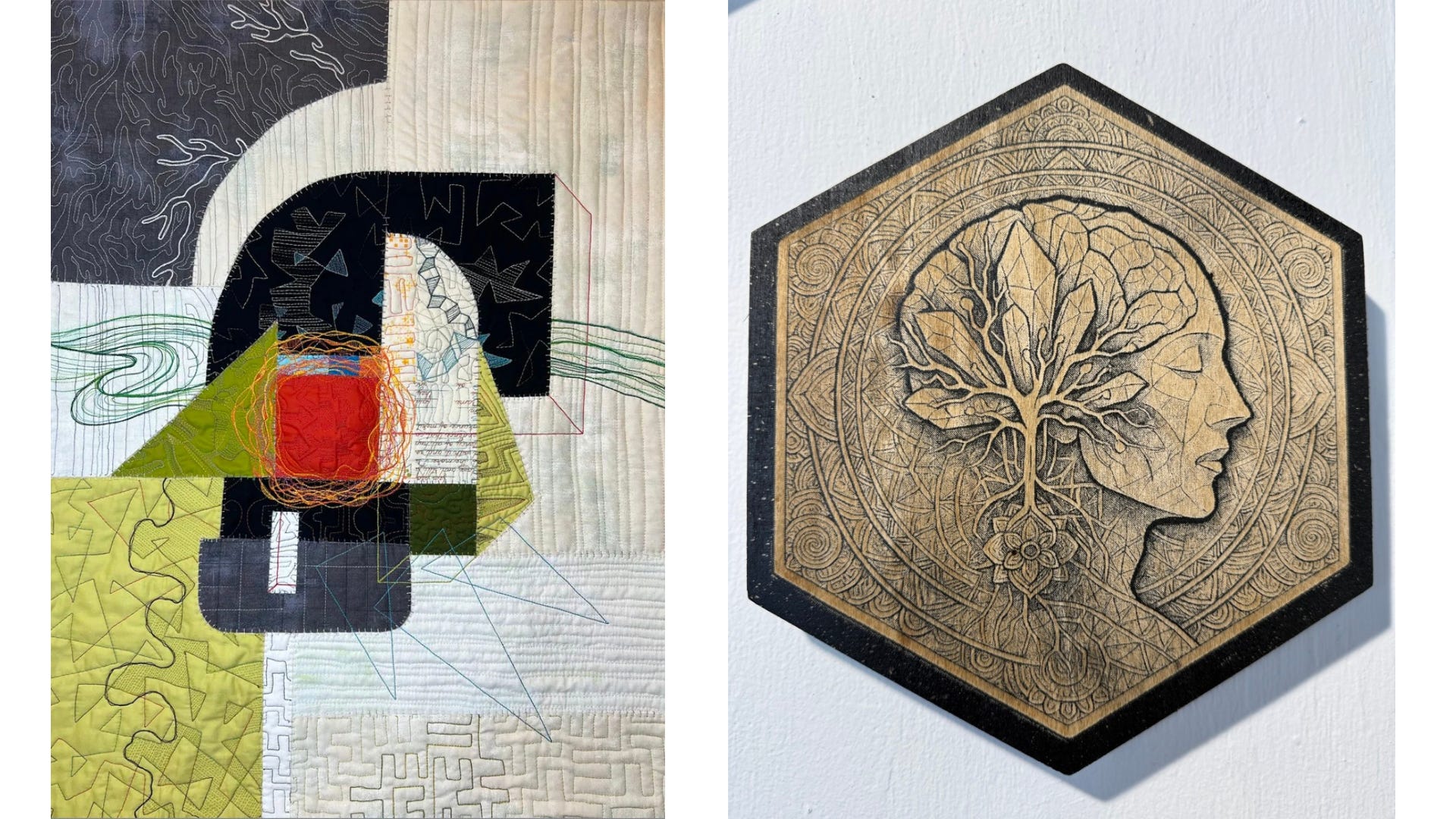
Where Lauri’s textiles are flexible and layered, Jeremy’s materials are fixed and elemental. Where her stitching creates pathways, his etched lines carve them. The work doesn’t compete; it converses.
Both artists are deeply invested in pattern, repetition, and the hand. Both understand time as a collaborator.
Common Threads Across Difference
This is where curating becomes less about matching and more about contrast.
Soft and hard.
Textile and mineral.
Flexible and fixed.
Large-scale and intimate.
What unites the work isn’t medium; it’s structure. Line. Repetition. Attention. The evidence of time and touch.
Contrast doesn’t confuse viewers; it sharpens their looking. It gives them multiple entry points and slows them down.
How I Compare, Contrast, and Select
When I’m testing a pairing, I imagine how the work will live in space. I think about how someone enters a room, where their eye lands first, and how it moves. I consider scale, pacing, and proximity. I picture the conversation before I ever see it installed.
This is especially true in alternative spaces like the historic Dunwoody Farmhouse. The rooms, hallways, and unexpected walls invite dialogue rather than neutrality. In this exhibit, Lauri’s work occupies its own room and extends into the hallway, allowing the textiles to breathe and assert their presence. Jeremy’s work holds its own room as well, creating contrast through proximity.
The architecture helps make those decisions visible.
Exhibits aren’t just displays. They’re arguments made visually.
Why This Makes the Exhibit and the Experience Stronger
When a duo show works, visitors linger. They move back and forth between pieces, noticing relationships and differences. They discover rather than consume.
The conversation doesn’t stop at the wall. It carries into the writing, the marketing, and the opening night itself. The exhibit becomes more than a collection of objects; it becomes an experience shaped by intention.
Curating as Relationship, Not Assembly
Looking back, Lauri’s work feels inevitable in this context, not because it demanded attention, but because it earned it over time.
Curating, for me, is about trust in artists, in instincts, and in paying attention to what continues to surface. Meaning isn’t built through accumulation. It’s built through thoughtful pairing, timing, and care.
Some artists don’t ask for immediate action. They stay with you. They surface once, make an impression, and then quietly linger, pressing at the edges of your thinking long after the opening or studio visit has passed. I’ve learned to pay attention to that feeling. It’s often where curating actually begins.
While it may be a frosty evening, you’re warmly invited to the opening of Taking Shape: Works in Textile, Wood, and Slate, on Friday, January 30, from 6:00 to 8:30 pm, at the Dunwoody Farmhouse.
I hope you’ll join us to see how these conversations take shape in space.